
Sendero‘s 3D Magnetic Model Identifies Multiple Porphyry and Epithermal Targets with Deep Roots at Peñas Negras
Oct. 08, 2026 Download PDF version
Vancouver, British Columbia – October 8, 2026 – Sendero Resources Corp. (TSXV: SEND) (FSE:9O40) (the “Company” or “Sendero”) is pleased to report results of advanced interpretation of airborne magnetic survey data from its Peñas Negras Project in La Rioja, Argentina, updating the exploration model and identifying targets for both epithermal and porphyry-style mineralization. The model indicates that key ingredients associated with porphyry districts in the Vicuña Belt (fertile intrusions, deep-rooted structures, multiple mineralizing centres and a preserved lithocap) appear to be present at Peñas Negras.
Highlights
- 3D inversion and classification of aeromagnetic data have produced a geological model of Peñas Negras to approximately 3 km depth.
- Several discrete, kilometre-scale magnetic bodies are interpreted as oxidized intrusions, characteristic of magmas associated with porphyry Cu-Au(-Mo) deposits.
- Lithocap, a favourable host for epithermal mineralization, is present across much of the project, indicating the upper levels of the system are preserved. Interpreted intrusions occur from subcrop to the maximum inversion depth.
- Stacked lithocap layers are consistent with more than one hydrothermal event.
- Near-vertical zones of magnetite-destructive alteration may mark deep fluid pathways, including beneath known mineralization at La Ollita.
"For the first time, we can see Peñas Negras in three dimensions," said Jeremy Gillis, Interim CEO of Sendero. "The model shows several large intrusive centres, a preserved lithocap and deep structures. Together, they point to a potential cluster of mineralized systems rather than a single target, with settings for both epithermal and porphyry-style mineralization. Historical drilling also shows the system sits where you want it: the top hasn't been eroded away, and the intrusive rocks beneath it are within drilling reach."
Peñas Negras 3D Magnetic Model Animation
The animation displays the 3D magnetic model, showing the four magnetic classes in colour: lithocap (cyan), magnetite-destructive alteration (blue-grey), andesitic host rock (yellow) and interpreted intrusions (red), with drill holes in their true positions.
At La Ollita, historical drilling sits near surface above alteration that extends to depth. At Cerro Verde Sur, the 2026 holes lie between two large, interpreted intrusions without reaching either. At Cerro Verde Norte, an interpreted intrusion rises close to surface beside the historical holes. The sections below illustrate the spatial relationship of distinct magnetic units, and in particular the widespread lithocap and several separate intrusive bodies.
Mapping Magnetic Classes in 3D
Classification is the statistical separation of data into predefined categories (supervised classification) to simplify the visualization and of overlapping ranges of data. Classification Applied to the 3D inversion of the aeromagnetic data, the classification defines four distinctive magnetic units:
- Class 1 (lowest susceptibility) forms a thin, flat-lying layer across much of the project, interpreted as lithocap.
- Class 2 (low to moderate) forms a thick horizontal layer with near-vertical chimneys, interpreted as hydrothermal root zones where alteration has destroyed magnetite.
- Class 3 (moderate) makes up most of the model, interpreted as the andesitic volcanic host rock.
- Class 4 (highest) forms steep, pipe-like bodies cutting the host rock, interpreted as intrusions.
What the Cross Sections Show
La Ollita. The model shows lithocap at surface, with a root zone of interpreted magnetite-destructive alteration extending beneath the known mineralization. Historical drilling is shallow, and the deeper part of the system has not been tested.
Cerro Verde Norte. Historical drilling by Anglo American (2011–2012) intersected lithocap hydrothermal breccia near surface and granitic intrusive rocks at depth, consistent with the geometry predicted by the model. Whether the granite is a mineralizing intrusion or older basement has not been determined.
Cerro Verde Sur. Three shallow holes drilled in 2026 intersected anomalous gold in the lithocap but did not reach the strongly magnetic body below (see news release dated August 17, 2026). This body remains untested.
Section 6879052N. Two stacked lithocap layers, approximately 9 km north of La Ollita, are consistent with more than one overlapping hydrothermal event (telescoping).
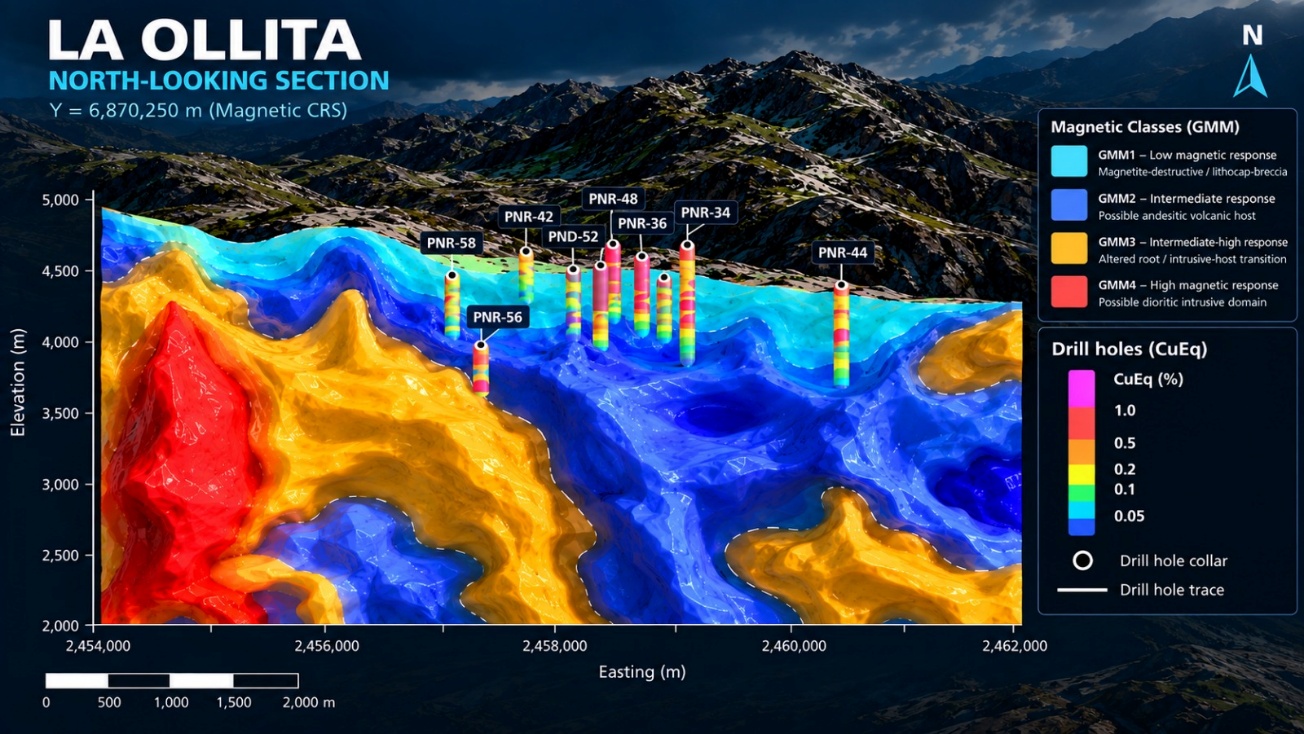
Cross Section looking north through the La Ollita occurrence: dark blue = lithocap, light blue = magnetite-destructive alteration along root zone under known mineralization, yellow = andesite volcanic host rock, and orange = diorite intrusives. Historical drilling projected into section.
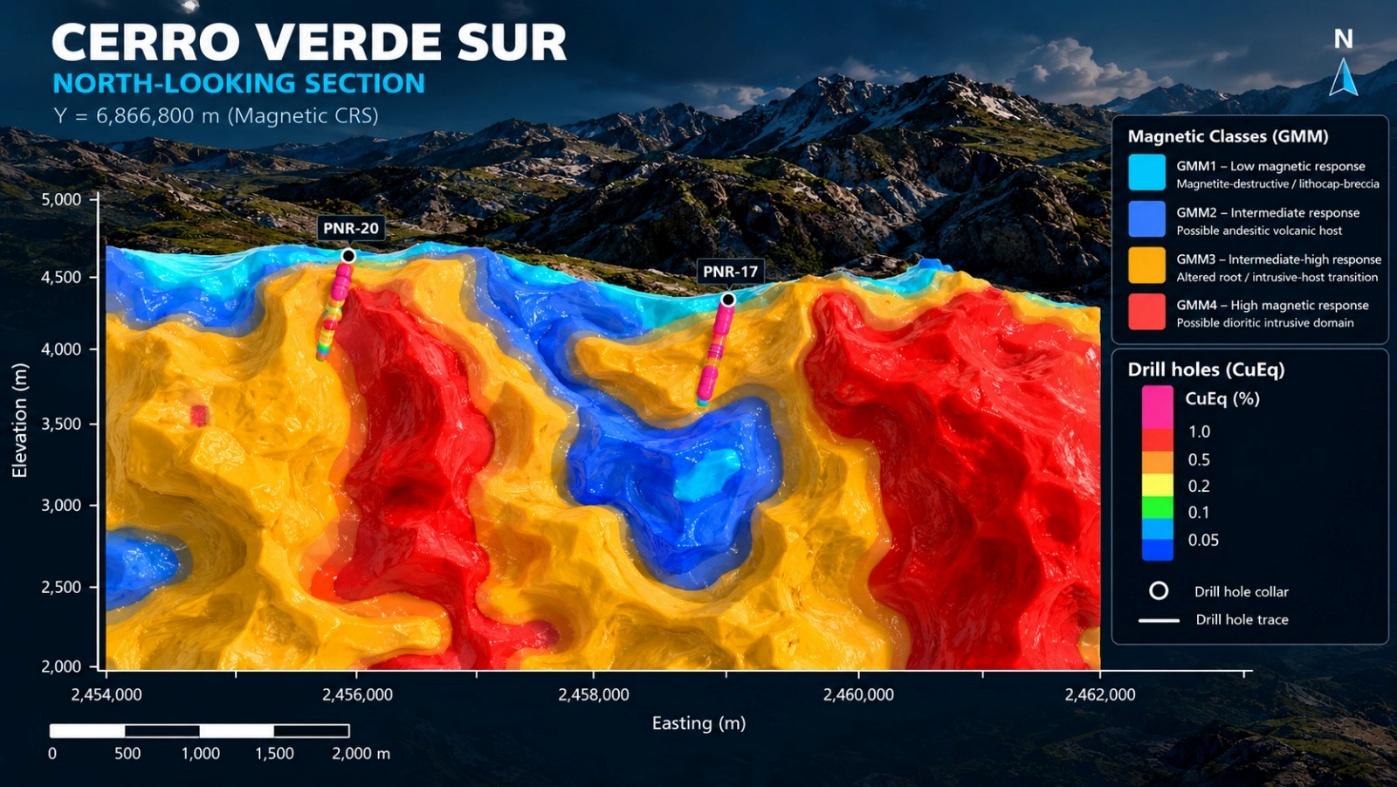
Cross Section 6866800N through the Cerro Verde Sur Target (3 km south of La Ollita): three shallow drill holes in early 2026 did not intersect the strongly magnetic intrusion, but assays indicate anomalous gold in the lithocap.
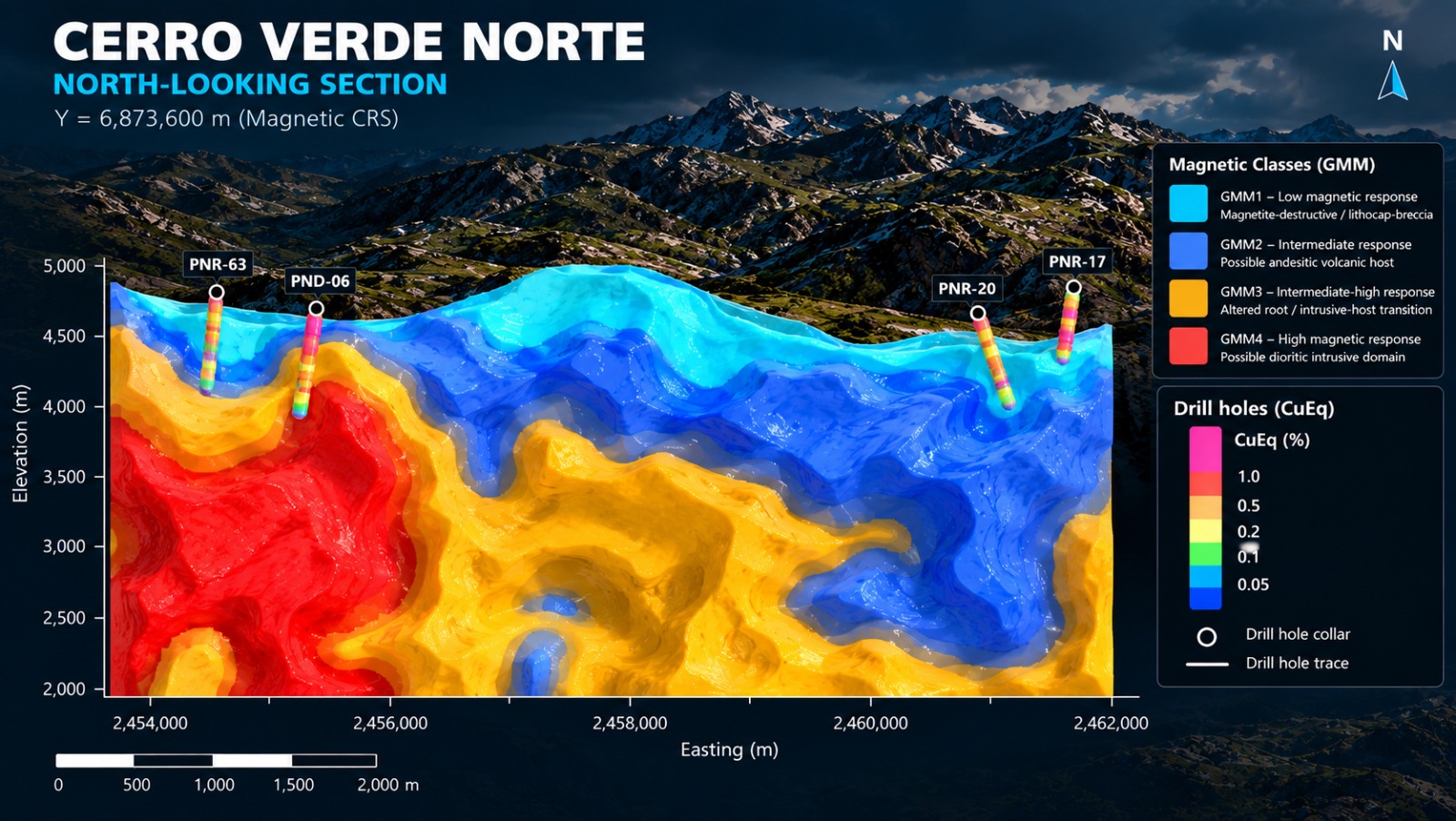
Cerro Verde Norte (2.6 km NW of La Ollita) section 6873600N, drilling by Anglo American 2011 – 2012, intersected lithocap hydrothermal breccia near surface and intrusive granite to End of hole.
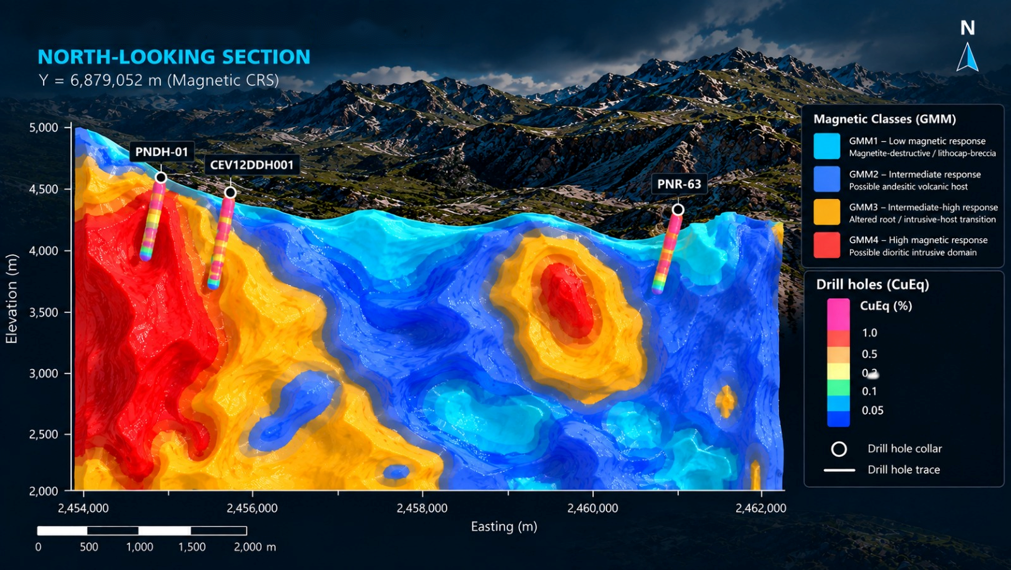
Cross Section 6879052N: Two layers of Class 1 indicates two stacked lithocaps, which is strong evidence of telescoping.
Why Magnetics: Mapping Geology Under Cover
Most of Peñas Negras is covered by glacial and alluvial sediments, which hide the bedrock from surface mapping but are largely transparent to magnetics. Magnetic response is controlled mainly by magnetite, which hydrothermal fluids can create or destroy, so magnetics maps alteration as well as rock type.
Surface geochemistry and radiometrics are two-dimensional and masked by overburden, while IP/resistivity and drilling are limited and shallow. Only the 3D magnetic inversion images the subsurface to kilometre-scale depth across the whole project.
Separating Overlapping Signals
Overlapping distributions of magnetic responses from different sources (rock types) can be statistically separated by assuming a normal (Gaussian) distribution for each source, creating statistical Classes. Classes can be then tied to the geology by direct measurement of magnetic susceptibility on representative rock types.
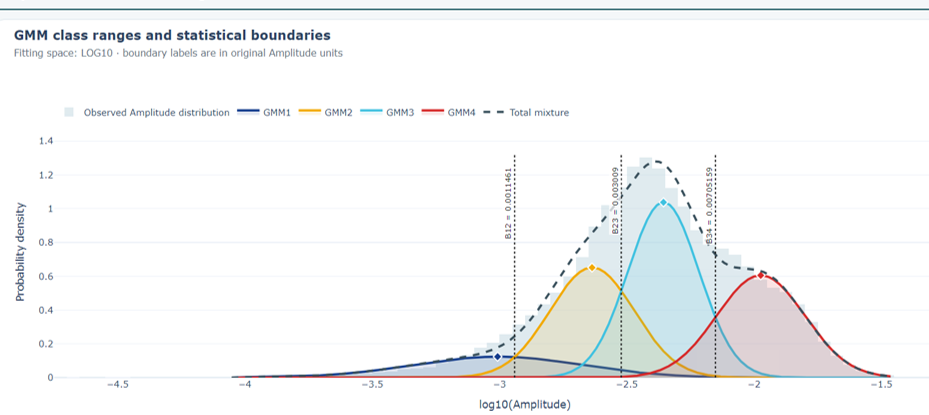
Separation of Classes by unmixing of Gaussian distribution histograms
Table 1. Magnetic classes from statistical classification of the 3D magnetic inversion
|
Class |
Interpreted unit |
Form in the 3D model |
Susceptibility range (×10⁻³ SI) |
Mean ± SD (×10⁻³ SI) |
|
GMM1 |
Lithocap |
Thin, flat-lying layer across much of the project; locally stacked |
0.02 – 1.15 |
0.98 ± 0.29 |
|
GMM2 |
Magnetite-destructive alteration (root zones) |
Thick horizontal layer with near-vertical chimneys |
1.15 – 3.01 |
2.31 ± 0.53 |
|
GMM3 |
Andesitic volcanic host rock |
Makes up most of the model volume |
3.01 – 7.05 |
4.41 ± 1.10 |
|
GMM4 |
Intrusions (interpreted diorite) |
Steep, pipe-like bodies cutting the host rock |
7.05 – 84.7 |
10.6 ± 4.65 |
Classes defined by Gaussian Mixture Model unmixing of the 3D susceptibility model; ranges are class boundaries. Geological interpretations are preliminary and will be checked against susceptibility measurements on drill core and outcrop.
Qualified Person
Steven McMullan, P. Geo., a consultant to the Company and member of the Board supervised the preparation of and reviewed and approved the scientific and technical information pertaining to the Peñas Negras Project contained in this news release. Mr. McMullan is a qualified person as defined by National Instrument 43-101 Standards of Disclosure for Mineral Projects.
About Sendero Resources Corp.
The Company is focused on copper-gold exploration at its 100% owned Peñas Negras Project in the Vicuña Belt in Argentina. The Peñas Negras Project has similar geological characteristics to other deposits in the Vicuña Belt and multiple porphyry and high-sulfidation epithermal targets have been identified on the project. The Company’s target area is located approximately 12 km north-northeast of the Josemaria resource area, while the centre of the Peñas Negras concession area is situated approximately 18 km southeast of Caserones mine operated by Lundin Mining, approximately 24 km northeast of NGEx Minerals’ Lunahuasi project, and about 32 km north-northeast of BHP-Lundin Mining’s Filo del Sol development stage project. The Company also has an option to earn a 100% interest on eight additional granted mining concessions covering 91.7 km2. The total project area comprises 211.77 km2.
Further Information
For further information, please contact:
Sendero Resources Corp.,
Jeremy Gillis, Interim Chief Executive Officer
Email: info@senderoresources.com
+1 (236) 232-0988
Follow Sendero Resources (@SenderoRes) on X, (Sendero Resources) on LinkedIn, and (@sendero_resources) on Instagram.
Cautionary Statement on Forward-Looking Information
This press release contains “forward-looking information” and “forward-looking statements” (collectively, “forward-looking statements”) within the meaning of applicable Canadian securities legislation. All statements, other than statements of historical fact, are forward-looking statements and are based on expectations, estimates and projections as at the date of this press release. Any statement that involves discussions with respect to predictions, expectations, beliefs, plans, projections, objectives, assumptions, future events or performance (often but not always using phrases such as “expects”, or “does not expect”, “is expected” “anticipates” or “does not anticipate”, “plans”, “budget”, “scheduled”, “forecasts”, “estimates”, “believes” or intends” or variations of such words and phrases or stating that certain actions, events or results “may” or “could, “would”, “might” or “will” be taken to occur or be achieved) are not statements of historical fact and may be forward-looking statements. Forward-looking statements are necessarily based upon a number of estimates and assumptions that, while considered reasonable, are subject to known and unknown risks, uncertainties, and other factors which may cause the actual results and future events to differ materially from those expressed or implied by such forward-looking statements. There can be no assurance that such statements will prove to be accurate, as actual results and future events could differ materially from those anticipated in such statements. Readers should not place undue reliance on the forward-looking statements and information contained in this press release. Except as required by law, the Company does not assume any obligation to update the forward-looking statements of beliefs, opinions, projections, or other factors, should they change, except as required by law.
Cautionary Statement
Neither the TSX Venture Exchange nor its Regulation Services Provider (as that term is defined in the policies of the TSX Venture Exchange) accepts responsibility for the adequacy or accuracy of this release.